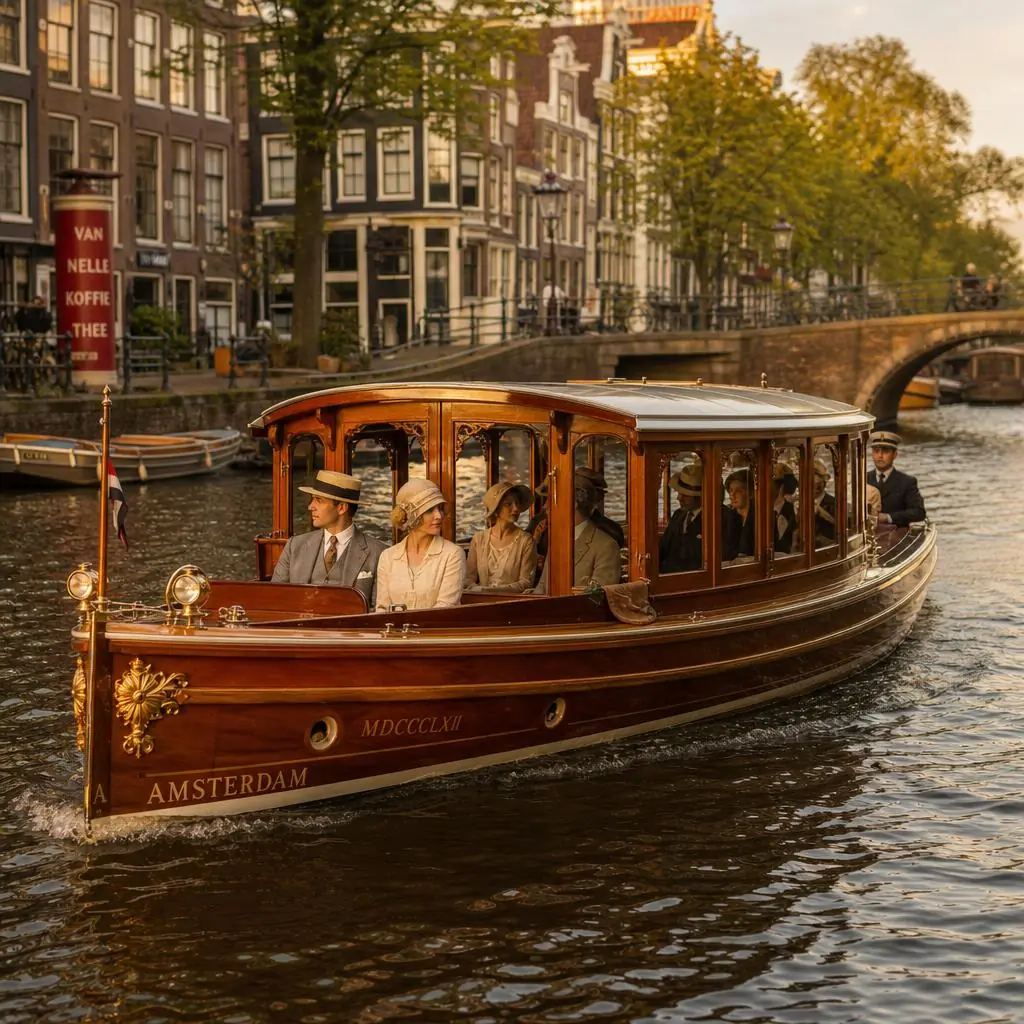

⚡ Quick Verdict & Recommendation
Quick Verdict & Recommendation:
- What they are: Fully restored pre-war wooden motor yachts (typically 1920s–1940s) with mahogany interiors, leather seating, and original brass fittings — for 6–12 people, private charter only
- Price range: €45–80 per person for a 90-minute private charter; full boat hire runs €450–900 depending on vessel, duration, and operator
- Who should book: Proposals, milestone anniversaries, small corporate events, or anyone who wants to be on Amsterdam's water in a vessel that genuinely belongs there — not a repurposed barge in a heritage costume
By Lisa van der Berg, Amsterdam local and canal cruise expert.
Amsterdam had a thriving boat-building culture in the early 20th century. The wooden motor yachts built in the 1920s and 1930s — for wealthy canal-house owners, harbour masters, and the occasional shipping magnate — were built to last, and some of them have. A genuine surviving vessel from that period is a different category of experience from a modern tourist boat, and the price reflects that.
The challenge is knowing the difference.
What authentic looks like
The signs of a genuine pre-war vessel are visible once you know what to look for:
Hull: Irregular planking with slight surface variation — you can see the individual plank edges under the varnish. Not perfectly flat laminate pressed into a "wood look."
Fittings: Handmade brass cleats, stanchions, and portholes with slight asymmetry from being individually forged rather than machine-produced. The tarnish patterns are irregular.
Engine sound: A genuine slow-turning diesel engine from the 1940s–1960s is unmistakable — a deep, irregular thud at idle that smooths slightly under load. Modern electric replicas are silent; modern diesel replicas have a higher, more regular sound.
Interior: Mahogany with real depth of grain and patina — not dark laminate. Leather upholstery with age-appropriate wear. A smell of wood, oil, and old fabric that you simply cannot replicate.
The replica problem
Amsterdam has roughly 15–20 operators marketing "historical salon boats." Of those, we estimate 6–8 are genuinely pre-war vessels. The rest are quality new builds or 1970s–1980s vessels with heritage styling. These aren't fraudulent exactly — they're often beautiful and well-made — but they're not historical in the sense that the marketing implies.
When booking, ask directly: year built, hull material (wood or fibreglass), engine type and year, last major restoration and what was replaced vs preserved. Legitimate operators answer these questions immediately.
When a salon boat makes most sense
Rainy days: A fully enclosed, heated mahogany cabin in the rain is one of the best canal experiences Amsterdam offers. The sound of rain on the deck, the warmth of the interior, the reflections on the dark canal water — it's atmospheric in a way that a glass-sided tour boat, however comfortable, cannot replicate.
Special occasions: The private nature and limited capacity (6–12 people) makes these ideal for proposals, anniversaries, and small family gatherings. There's no audio guide, no crowd, and no schedule pressure.
Photography: The aesthetic of a pre-war vessel against Amsterdam's 17th-century canal facades is visually coherent in a way that modern boats are not.
For the full picture on operators — including price context for mainstream tours — see the operator comparison page. Salon boat operators typically don't sell standard tickets, but the comparison gives you a useful price baseline.
Night photography from a salon boat
Historic salon boats offer a specific photographic advantage after dark: the combination of pre-war wooden hull, brass fittings, and 17th-century canal facades creates a visual coherence that no modern tourist boat can replicate. The aesthetic is a natural match.
The Westerkerk at night: The tower is illuminated until midnight. From the water level of a salon boat, framing the tower against a dark sky — through the narrow bridge arches of the Keizersgracht — produces a photograph you simply cannot replicate from street level.
Bridge reflections: The low profile of a salon boat puts you closer to the water surface than a standard tourist boat, giving you a wider view of bridge reflections.
For a complete photography guide covering locations, timing, and settings, see our evening photography guide.
Amsterdam Light Festival (November–January)
If you're visiting between late November and mid-January, a few operators run historic salon boat charters specifically timed for the Light Festival route. These are private charters (your group only), follow the festival installation route, and include a knowledgeable guide who explains each artwork.
Prices: typically €90–120 per person for groups of 6–10, 90 minutes. Must be booked 6–8 weeks in advance — these fill up in October.
For the full picture on Light Festival boat tours including the standard (cheaper) options, see our Amsterdam Light Festival guide.
Affiliate disclosure: This article contains affiliate links. We may earn a small commission if you book through our links, at no extra cost to you. Our recommendations are editorially independent.