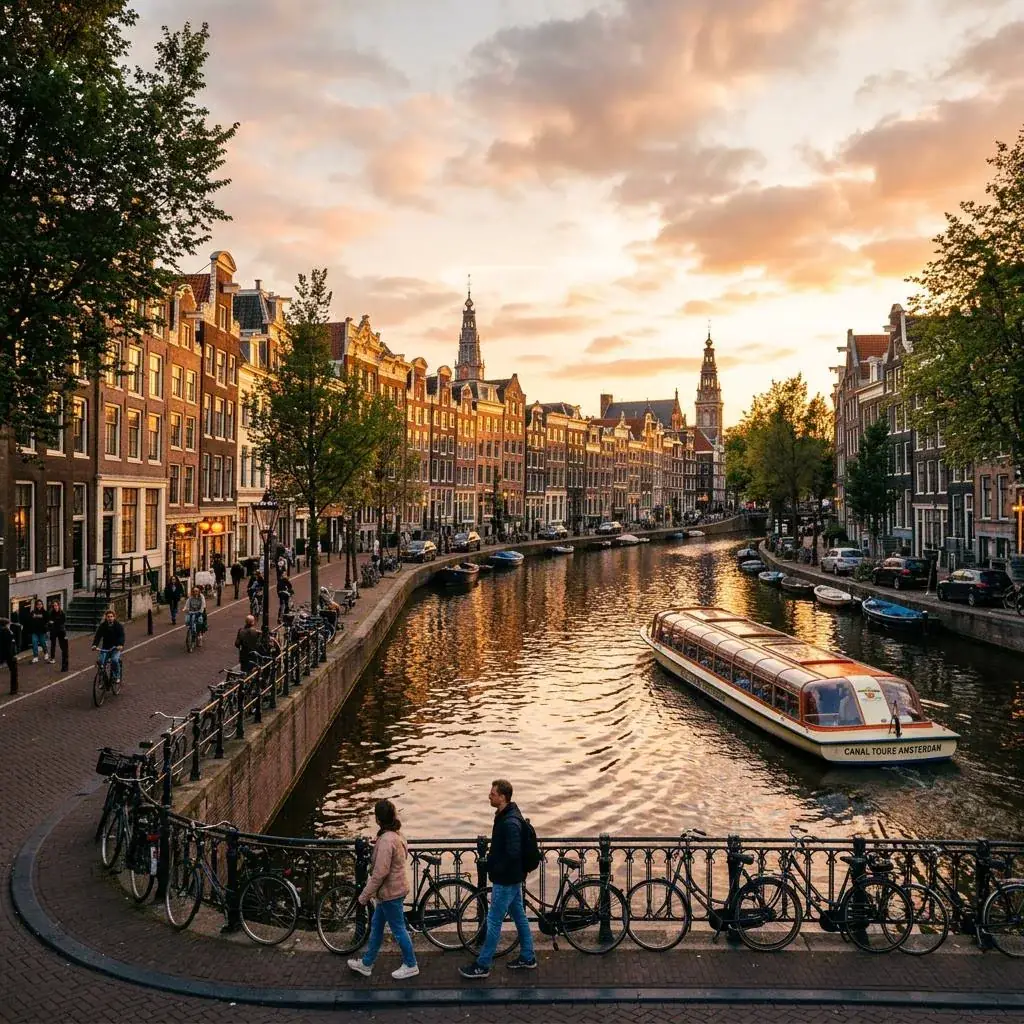

⚡ Quick Verdict & Recommendation
Quick Verdict & Recommendation:
- What they are: Hofjes are 17th-century almshouse courtyards hidden behind narrow street-level gateways — from the street, you see almost nothing; from the water, the full depth of the garden and rear facades opens up
- Best canals: Bloemgracht and Egelantiersgracht have the highest concentration of hofje access points per kilometre of waterway
- How to see them: Standard Lovers/Blue Boat tours don't go here — you need a private electric sloop or a specialist Jordaan boat tour
By Lisa van der Berg, Amsterdam local and canal cruise expert.
Every canal cruise brochure in Amsterdam will tell you about the Anne Frank House and the Golden Bend. Almost none of them mention the hofjes.
There are 47 officially registered hofjes in Amsterdam — enclosed charitable courtyard complexes built in the 17th and 18th centuries, originally funded by wealthy merchants to house widows and the poor. From the street, they're easy to miss: you get a sliver of a gate, maybe a carved stone lintel, then a wall. Walk past it and you'd never know there's a lush garden courtyard behind it, sometimes 40 metres deep.
From the water, it's an entirely different story.
What the boat reveals
Our team spent three mornings on hired electric sloops, working slowly through the Jordaan's network of minor canals. The Bloemgracht opens up the back sections of several hofjes in a way that's simply impossible from any street. The Karthuizerhofje — built in 1650 for 52 widows — has its rear garden running directly to the canal edge. At low tide, you can see the original stone retaining wall, mossy and tilted, built before Amsterdam's foundations were fully understood.
The Claes Claeszoon Hofje on the Egelantiersgracht is trickier — it's set back slightly — but with binoculars from a slow boat, the wrought-iron entrance gate is clearly visible, and the scale of the complex behind it becomes apparent in a way that the narrow Egelantiersgracht street entrance never suggests.
The honest catch
Let us be direct: most of these courtyards are protected by walls or hedges that block a complete view from the water. What you see is suggestion more than spectacle — a roofline above a wall, a tree canopy rising from a seemingly solid block of buildings, a gate that implies depth. That partial view is actually the point. It's what makes the city legible in a completely different way when you're on the water.
If you want a full narrated tour of the Jordaan's architectural history from the water, compare the specialist operators before booking — several offer small-group Jordaan canal tours with a local guide who will actually point these things out, unlike the standard audio-guide boats.
Practical notes for the trip
What to hire: Electric sloops for 4–6 people give you the most flexibility. You navigate at your own pace and can slow down or stop, which the big tourist boats cannot.
Best time: 09:00–10:30, before other boat traffic creates wash that makes photography difficult.
Navigation tip: Bloemgracht → Egelantiersgracht → Leliegracht is a natural loop that takes about 90 minutes at walking pace. It connects back to Prinsengracht without retracing your route.
For a comparison of all canal cruise options — guided tours to self-hire — see the operator comparison page.
The Most Notable Hofjes: What You See From the Water
Many hofjes are located directly on the water or have an entrance visible from a canal boat. These are particularly worth noting:
Hofje van Brienen (Prinsengracht 85–133): The entrance is visible from the water. One of Amsterdam's best-preserved hofjes, founded in 1804 by a wealthy merchant as housing for women in need.
Karthuizershofje (Karthuizerstraat): A larger hofje, less well-known, but with a remarkably tranquil atmosphere. The water channel behind it is navigable by small private boat.
Etiquette When Visiting
Hofjes are partly inhabited. Entry rules are posted at the gate: photography is often permitted, but silence is required. Noise and large groups are not tolerated by residents — and rightly so.
We visit the Jordaan hofjes two or three times per year and are struck each time by how few tourists make it here, despite being only a few streets from the busiest canal routes.
Affiliate disclosure: This article contains affiliate links. We may earn a small commission if you book through our links, at no extra cost to you. Our recommendations are editorially independent.