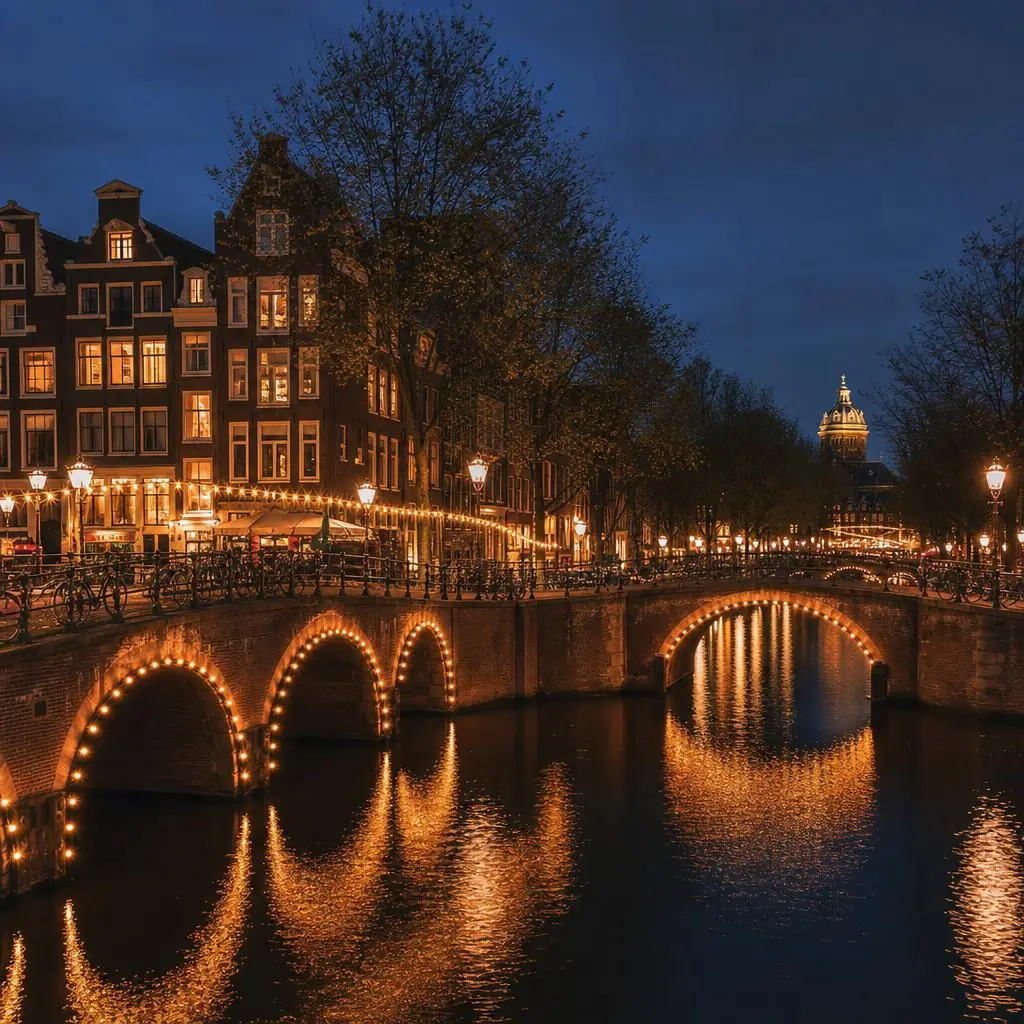

⚡ Quick Verdict & Recommendation
Quick Verdict & Recommendation:
- Location: Reguliersgracht, at its intersection with Keizersgracht — looking south, seven bridges stack up in a single optical alignment
- Your window: Approximately 8 seconds as the boat passes through the optimal viewing angle — have your phone or camera ready before the bridge
- Best seat: Port side (left side as you face forward), secured before you reach Keizersgracht — standing room at the railing, not seated
By Lisa van der Berg, Amsterdam local and canal cruise expert.
Here is what the travel sites don't tell you about the seven-bridges view: it's harder than it looks, it lasts about as long as it takes to read this sentence, and most people on tour boats miss it entirely.
We took this specific shot from four different boats, at three different times of day, to work out what actually matters.
The geometry
The seven bridges don't sit on a straight line. They're on slightly offset canals — the Reguliersgracht itself provides three bridges, and the intersecting cross-canals provide four more. What creates the "seven bridges" effect is an optical compression: standing (or sitting) at the exact intersection point of the Reguliersgracht and Keizersgracht and looking south, your eye reads the parallel bridges as a single receding sequence.
At any angle other than this precise point, you see five bridges, then four, then three. The alignment is that specific.
The problem with tour boats
Standard canal cruise boats travel at 5–7 km/h. That's fast enough to pass through the alignment in roughly 8 seconds. In that window: you need to be standing, camera up, on the correct side, with a clear sightline past other passengers.
On a full 80-person boat in July, the port-side railing has roughly 15 people competing for the same spot. Unless you've positioned yourself 5 minutes before the bridge, you're looking at someone's shoulder.
On a private electric sloop or small group boat, you can slow down, even stop, within the alignment. That's a meaningful difference — the difference between a snapshot and an actual photograph.
The photography reality
In bright direct sunlight, the bridges create harsh shadow across themselves and the canal. The shot that works best is either: overcast flat light (which reveals the stonework of each arch), or golden hour (April–September, 19:30–21:00), when the warm directional light picks out the bridge curves without the midday contrast problem.
Night photography during the Amsterdam Light Festival (November–January) is also compelling — the illuminated bridges stack up in a completely different colour palette.
For a breakdown of which operators include the Reguliersgracht on their routes, see the full operator comparison. Not all standard tours go this way — check the route map before booking.
The quick version
Go early or go at golden hour. Sit on the left. Have your camera out before you reach Keizersgracht. Don't blink. And if you're serious about the shot, hire a sloop rather than taking a group tour — the 8-second window makes all the difference.
The History Behind the View
The Reguliersgracht was created in the seventeenth century as part of the systematic canal ring expansion that began in 1613. The name refers to the regulated sluices that once controlled water levels in this section of the system.
The seven bridges that form today's iconic view were built over several centuries. The oldest dates from the eighteenth century, the newest from the early twentieth — but from this perspective they all appear the same age, because Amsterdam enforces strict rules for maintaining the historical appearance.
Other Bridge Perspectives in Amsterdam
If you like the seven-bridges view, these are also worth knowing:
Brouwersgracht at Prinsengracht: Two canals cross here, with houseboat-lined banks on all sides. Less dramatic than the Reguliersgracht, but more atmospheric.
Keizersgracht 546: From this point, four bridges are visible in one line — less well-known than the seven-bridges view but equally only readable from the water.
We've photographed both locations extensively and confirm: the Reguliersgracht gives the strongest composition, but the Brouwersgracht corner has the better atmosphere at dusk.
Affiliate disclosure: This article contains affiliate links. We may earn a small commission if you book through our links, at no extra cost to you. Our recommendations are editorially independent.